
A Shocking Myth About Happiness
 I am almost finished reading a fascinating book written by psychology professor Sonja Lyubomirsky called ‘The Myths Of Happiness‘. (al)
Any book that ruthlessly attacks self development myths is always going to grab my attention especially if its claims are supported by hard scientific data.
In ‘70 Amazing Facts About Your Brain‘ I talk a lot about cognitive biases or blind spots in our thinking and how important it is to recognize them.
It seems Lyobomirsky has helped uncover a blind spot of biblical proportions (prior research had been done with similar conclusions), and brought it into the full glare of the public spotlight.
Do Kids Increase Your Happiness Levels?
Most wannabe parents would confidently predict that having kids will make them happier, after all, why else would they want them?
And I’m sure that most parents would cement that belief by announcing that they have felt happier since having their own children.
Yet statistically speaking both groups would be wrong.
Having a family does not increase happiness levels and can actually have the opposite effect.
I have to say I wasn’t particularly surprised by the findings of the latest research, although I know many will be.
Maybe that’s because I don’t have any kids and can watch friends who do worry themselves sick over their offspring and bemoaning their lack of cash, a social life and sleep.
I recently had a client who was very unhappy in her work but didn’t want to quit (even though she could have financially speaking and scrapped by).
She felt a deep obligation to save enough money so her son would never have to worry about school tuition fees.
That’s very understandable, but at the same time I highly doubt her son will be glad his mom went through a decade of misery just so he could avoid having to take out a student loan at some point in the future.
Social Taboos
It’s almost entirely unacceptable from a social standpoint to admit your happiness levels dropped after starting your family.
On the scale of social no-no’s it’s only slightly less taboo than giving a speech at your local Rotary Club on the benefits of Devil worship and virgin sacrifices.
Not only that, but most people wouldn’t even even admit to thinking something like this even to themselves. It’s scary, disloyal and would probably create terrible feelings of cognitive dissonance.
Therefore, I would imagine most parents will presume they’re statistical outliers or that the research is flat out wrong and it’s just another example of over zealous scientists looking to make headlines.
And they will have arrived at that conclusion by searching their memory for all the amazing times they have shared with their kids.
The first smile, the first word, the first few wobbly steps and any other number of happy events and quality time.
It’s less likely they will call to mind the first time he threw up over the carpet, the first time she threw a tantrum in the Supermarket, or in the case of one friend, the first time the little rascal shoved a screwdriver through the screen of his new plasma TV.
Not All Cognitive Biases Are Bad Things
In this respect I think some blind spots or cognitive biases can be good thing.
Even if starting a family isn’t likely to increase happiness levels, few parents actually regret the decision to do so and the vast majority love their kids no matter what.
This post (or rather the book) isn’t all doom and gloom though because what Lyobomirsky (a mother herself) does throughout is to offer solutions that will help improve your happiness levels in all areas of your life, including with your kids.
So don’t think you have to drop the kids off at kindergarten and head for the hills (without your spouse by the way, because another myth she explodes is that married people have higher happiness levels) to be joyful.
A less traumatic and expensive approach would be to buy the book and utilize the practical information within.
My only slight reservation with ‘The Myths of Happiness’ is there’s some duplication of material from her first equally excellent book, ‘The How Of Happiness’, but other than that very minor quibble I’d highly recommend it.
By the way, I’ll be making mention of the book in my February newsletter (due out this week) and sharing a super cool tip that helps you let go of the past.
I was just sent a link to this interesting and optimistic Ted talk that covers this topic if you want to know more.
70 Amazing Facts About Your Brain
– The Video
My good friend Jerry Eisinger helped me (ok he pretty much did it all) make this video trailer for the book.
It’s only a couple of minutes long and I really think he’s done an excellent job. I’d love your take if you are so inclined.
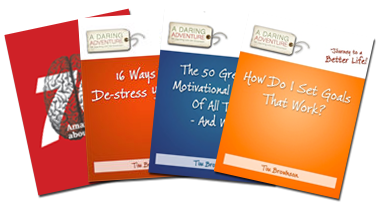
If you haven’t already got your copy, you can grab the Kindle version here or sign up for my newsletter and get the PDF version as well as 3 other of my ebooks.
I’m sorry, doesn’t anyone live in families any more? Has everyone stopped associating with people who are in families now? This whole article is about false expectations disconnected from reality. I do find it hard being sympathetic with such people. If you ignore reality, don’t complain to me if it turns around and bites you on the backside.
Whose reality is that Phil, yours?
I have no idea what your point is but I promise not to complain to you about anything.
As a mom and wife myself, I love studies like this! I wonder, though, what those people’s happiness level was before they had kids. My observation is that most moms, at least first time moms, are basket cases — they worry about every little thing to the point where I wonder if they think about anything else. I wonder if many women aren’t already prone to this type of behavior before they had kids. I tend to be on the other extreme — I don’t worry about things with my son unless I think it’s serious. I think that might help my happiness level because I can have a more balanced life?
Anyway, just some musings. Happiness is something I’ve always been interested in and thought about on an active basis. I’m so glad you reviewed this book!
I LOVE how a previous commenter (Lisa) says that kids are wonderful and completely miserable all at the same time. Couldn’t have said it better myself!
Ha, I just noticed the logo and realized which Trish you are. Thanks for dropping by!
They did ask people to rate their happiness levels now compared to when they were childless, that was part of the study.
However, people often have a rosy eyed view of the past so how accurate that can ever be is debatable.
Yes, it’s true, but most people don’t get that message until it is too late. Your can quit your job, you can leave your spouse, but you can’t take back your kids.
Here’s my Read.ing. Happily. Stop by, if you can, and share your thoughts.
And to be fair I don’t think many parents would want to go that far!
Wow, never heard of that book before but I just wrote about this the other day. I’m doing my part to show people the difference between temporary elation and real joy through enrichment and flow.
Thanks Tim.
You’re ahead of the curve mate!
Hey Tim. That book sounds amazing, I’ll have to check it out (eventually). I’ve still not read your ebook either, sorry!
Jerry has done a brilliant job with the promo video. I’ll be sharing it on Facebook in a sec. I love your videos. I’d really like to see you do more. Maybe a semi-regular feature on the blog, once per month/quarter?
Cheers dude!
I’m already on it thanks and definitely going to do more videos this year.
I have three kids 5 and under, and I think this hits it right on the nose. Kids are wonderful and completely miserable–often even both at the same time.
I am new to the phenomenon that is life coaching and have gratefully stumbled upon your site, Tim. I’m really glad to see someone who has a greater tone of realism, or as I like to call it, sarcasm. I’ve seen too much of life coaching that is all fluffy, touchy-feely, make-you-feel-good-while-just-maybe-making-a-change-or-two blabber. Thanks for telling it like it is.
Thanks a lot Laura, glad you enjoyed the post and I appreciate the kind words.
Hmmm… I guess it would depend on how you define “happiness.” Am I always bubbling, smiling, cheerful and chatty? Is it as “fun” as being childless? No. I’ve been exhausted, depleted, worn out, driven sick, worried, etc, etc. We don’t go out much (our kids are still young).
But, like Susan, I think happiness needs to be discussed slightly differently:
– There is a deep happiness from the growth I’ve had from being a parent. There is maturity, wisdom, insight, and other growth that has come that I don’t know if I would’ve have accessed without it.
– There is a fulfillment that really is beyond words- it’s hard to describe- mystical- in having family.
So I would say that I am much, much happier in the depths of my heart. And the happy, cheerful moments are amazing.
So Tim- honest question- is she defining happy as “fun” or happy as “deeply fulfilled”? How was she contextualizing the word “happy” when speaking with people or measuring it?
The experiment asked people to rate their own happiness levels on a regular basis (I think they were alerted by text at random intervals). They also used the method that is talked about a lot in positive psychology and I can’t remember who developed/discovered it, but basically it suggests you need a minimum of 3 positive events (4 or higher is ideal) to every negative one to be seen as being happy overall.
Happiness is a tricky sucker to pin down, but would it *sounds* to me like your describing is more akin to contentment and fulfillment maybe?
I hear you, and yes, contentment/fulfillment, sure- but I don’t know how to isolate those feelings one from another within me. If I’m contented and fulfilled, and I’m certainly not unhappy- I sense my contentment, and I feel my happiness. Many moments aren’t fun, but there is a deeper feeling of happiness underneath that which I can usually access if I catch my breath.
And many moments are, of course, fun. But we’re just talking about the other.
Maybe I’m an anomaly, but I just question the idea of trying to disconnect happiness and fulfillment to make a claim like this.
That said, I think it’s extremely useful to create space for parents to voice dissatisfaction, struggle, pain, and the unhappy/unfun moments of parenting. This past week has not been fun, for sure, with the whole family sick. Parenting sick kids while sick is a special kind of challenging situation. :)
Well there certainly will be anomalies Mark and as such you may be one.
My understanding of how they measured happiness was to simply ask the question “Do you feel happy”
Most people will tend to answer that yes or no. Others will need to write a 50,000 word thesis ;-)
It reminds me of the scene in Love and Death with Woody Allen when he asks Diane Keaton (I think) whether she loves him.
She stumbles and says something like “What is love? There are many types of love. There is the love of a mother for her children or the love of a husband for his wife”
At which point Allen buts in and says:
“yes and let’s not forget my favorite type of love, that of a women for another women”
Mark, you have a great point. The word “happiness” has a wide variety of meanings. The research would have been more useful if it had used more precise definitions. However, the evidence is still compelling and very interesting.
You can’t define happiness in any other way than asking people if they feel happy imho. It means different things to different people.
I’m the mother of five, ages 20 to 7. Married to the same guy as of yesterday for 28 years. Without the growth afforded by having children, I would be in some other place in my life. I think I would probably be more self-centered and less compassionate. My children have made contributions along the way that have led to some of my most joyful joys and my most painful pains. But the combination of all of it has brought me to a place of deeper honesty, understanding compassion for myself and others, and a much greater belief in empowerment. At the same time, I do know that having 0, 1, 2, 3, or 4 kids seems like a SNAP! to me from this point of view. Even five, without a special needs child (my 5th has DS) seems pretty doable. But the growth each if these kids has afforded in me, and the richness that my life has because of every one of them, is priceless, even if the results have required my best efforts and a lot if grace.
Hey Susan, it sounds like you have done a great job, raising 5 kids is pretty amazing, to me anyway!